What Is a Pattern Interrupt?
A pattern interrupt is a technique that deliberately breaks someone’s expected mental routine, forcing them to stop and pay attention instead of defaulting to an automatic response.
The concept comes from Neuro-Linguistic Programming (NLP) and behavioral psychology. The idea: humans operate on autopilot for most routine interactions. When a cold caller says “Hi, how are you today?”, the prospect’s brain doesn’t even engage — it fires off a pre-loaded response (“I’m busy, not interested, take me off your list”) because it’s heard that opener a thousand times.
A pattern interrupt disrupts that autopilot. By saying something unexpected, you create a brief cognitive gap — a moment where the prospect has to actually think about how to respond instead of reaching for a canned rejection.
In sales, the technique is used in cold call openers, email subject lines, voicemail scripts, and LinkedIn outreach to cut through the noise and earn a few seconds of genuine attention.
Why Pattern Interrupts Work (The Psychology)
Three mechanisms make pattern interrupts effective:
Breaking automaticity. Psychologists estimate that 40-45% of daily human actions are habitual — performed on autopilot. When you cold call someone, their response to an unknown number is equally habitual: screen the call, or answer and immediately look for an exit. A pattern interrupt disrupts the habit loop, forcing the brain out of its automatic rejection sequence.
Cognitive disruption. When something unexpected happens, the brain pauses to process the new information. This creates a brief window — maybe two to five seconds — where the prospect is genuinely present and listening. That window is your opportunity to say something relevant enough to keep them engaged.
Heightened suggestibility. When an expected pattern breaks, the subconscious has to “reboot.” During that moment of reorientation, people are more receptive to new input. This doesn’t mean they’re manipulated — it means they’re actually hearing what you’re saying instead of reflexively dismissing it.
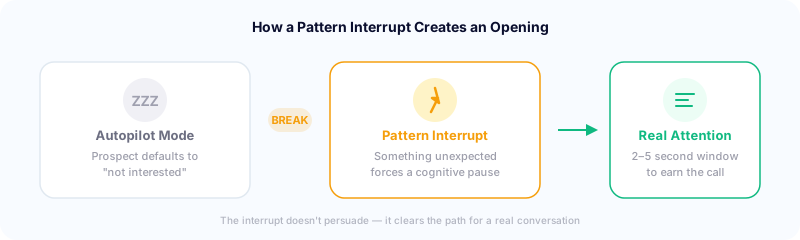
The key insight: pattern interrupts don’t persuade anyone. They just clear the path for a real conversation by preventing the automatic “no” that kills most cold calls before they start.
Cold Call Openers That Work
Here are pattern interrupt openers used by top-performing SDRs, along with why each works:
The Honesty Opener
“Hi [Name], I’ll be honest — this is a cold call. You can hang up if you want, but can I get 30 seconds to tell you why I called?”
Why it works: Nobody expects a cold caller to admit it’s a cold call. The disarming honesty disrupts the prospect’s expectation of a pushy pitch, and the explicit permission to hang up reduces their defensive posture.
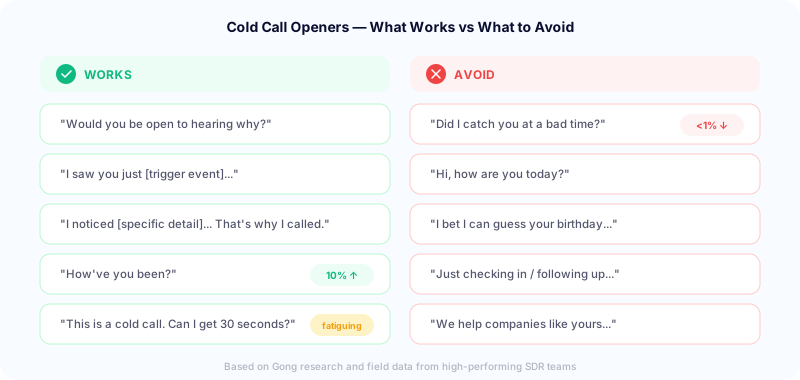
Watch out: This opener went mainstream around 2022-2023. By 2026, many prospects have heard it. It still works — but it’s losing its edge. If you use it, make the 30 seconds after it count. Don’t follow honesty with a generic pitch.
The Specific Time Opener
“Hi [Name], I need exactly 27 seconds. Can I have them?”
Why it works: The odd number (27 instead of 30) grabs attention because it’s unexpected and specific. Research from Gong shows that odd numbers create more curiosity than round numbers. It also implies you’ve timed this — you’re prepared, not winging it.
The Research-Led Opener
“Hi [Name], I noticed [specific detail about their company — a recent hire, a product launch, a quarterly result]. That’s actually why I’m calling.”
Why it works: Personalization at the start signals “this isn’t a mass dial.” According to sales engagement data, personalized cold calls increase engagement by 72% compared to generic scripts. The pattern interrupt here is relevance — the prospect expects a generic pitch and instead hears something about their world.
The Accusation Audit (Chris Voss Method)
“Hi [Name], I know this is awkward — you don’t know me and I’m interrupting your day. You’re probably going to want to hang up. But before you do, can I tell you the one reason I called?”
Why it works: Popularized by former FBI hostage negotiator Chris Voss, the accusation audit pre-empts the prospect’s objections by voicing them first. This disarms resistance because there’s nothing left to push back on.
The Permission Opener
“Hi [Name], I know I’m calling out of the blue. Would you be open to hearing why, or should I try another time?”
Why it works: This gives the prospect genuine control — and that’s the interrupt. Most cold callers barrel into a pitch. By asking permission and offering an out, you signal respect for their time. Paradoxically, giving them the option to say no makes them more likely to say yes. It also pre-qualifies: if they say “go ahead,” you know you have real attention, not polite tolerance.
The Trigger Event Opener
“Hi [Name], I saw you just [specific trigger — opened a new office, posted a sales hiring role, launched a new product]. That’s usually when teams start thinking about [relevant problem]. Is that on your radar?”
Why it works: This goes beyond generic research. A trigger event is timely and relevant — it shows you’re not just reading their LinkedIn bio, you’re tracking their business. The question at the end invites dialogue instead of a monologue.
The “How’ve You Been?” Opener
“Hi [Name], how’ve you been?”
Why it works: Gong data shows this opener achieves a 10.01% success rate in booking a second interaction — 6.6 times the average cold call success rate. It works because it implies familiarity. The prospect pauses to think, “Wait, do I know this person?” That pause is the interrupt.
Important caveats: This works best when delivered naturally and confidently — if it sounds rehearsed, it falls flat. Some prospects will feel misled when they realize they don’t know you, so be ready to transition smoothly: “We haven’t spoken before, but I’m calling because…” Also: “Did I catch you at a bad time?” does the opposite — Gong data shows it has less than a 1% success rate, performing 40% below the average baseline. Avoid it.
Email Pattern Interrupts
Pattern interrupts work in email subject lines and body copy too. The goal is the same — break the expected pattern so the recipient opens and reads instead of auto-archiving.
Subject line techniques:
- All lowercase — “quick question about [their company]” stands out in a sea of title-cased marketing emails. Tests show lowercase subjects can double open rates in some segments.
- Specificity over cleverness — “saw your 2026 hiring plan” outperforms “exciting opportunity” because it signals research, not spray-and-pray.
- Odd numbers — “3 things your SDR team is doing wrong” beats “tips for your SDR team.” Numbers in subject lines see roughly 20% higher open rates than text-only subjects.
Body copy techniques:
- Lead with their world, not yours. Open with an observation about their business, not a pitch about your product.
- One sentence, one CTA. Don’t bury the ask in paragraph three. Keep the email short enough that the CTA is visible without scrolling.
- Ask a question they want to answer. “Are you seeing lower answer rates on outbound calls this quarter?” is more engaging than “We help companies improve answer rates.”
Voicemail Pattern Interrupts
About 80% of cold calls go to voicemail. Most reps leave forgettable messages. A good voicemail doesn’t try to close — it warms up the email that follows.
Structure (under 20 seconds):
- Your name + company (fast)
- One specific reason you called (tied to their situation)
- Your phone number (said slowly)
- No pitch — just enough to make them curious
Example:
“Hi [Name], it’s [Your Name] from Symbo. I saw [specific detail — e.g., you’re scaling your outbound team]. I have a quick thought on that — my number is [number]. If I don’t hear back, I’ll send a short email.”
Why it works: It’s short (most voicemails are too long), specific (not generic), and sets up the email follow-up as the real touchpoint. The voicemail is the interrupt; the email carries the substance. With a multi-channel sequence, you can automate this — the voicemail step triggers the follow-up email automatically.
Common Mistakes (What Kills a Good Interrupt)
Being gimmicky. If your opener sounds like a trick, it backfires. “I bet I can guess your birthday” might get a chuckle, but it doesn’t build the kind of trust that leads to a meeting. The best interrupts feel natural, not performed.
Overusing the same interrupt. Any technique that becomes widespread stops working. “This is a cold call” was novel in 2022. By 2026, many prospects have heard it. Watch for fatigue and rotate your approach.
No follow-through. Getting attention is step one. If you earn 30 seconds with a great opener and then launch into a generic pitch, you’ve wasted the interrupt. Follow it immediately with something relevant to their specific situation.
Wrong audience. C-suite executives and junior SDRs respond to different things. A playful opener that works on a 25-year-old sales rep might land poorly with a CFO. Match the tone to the person.
Talking at, not with. The interrupt opens a door. Walk through it by asking a question, not delivering a monologue. The best follow-up to any pattern interrupt is a genuine, relevant question that invites dialogue.
Pattern Interrupts and Objection Handling
Pattern interrupts aren’t just for openers — they’re powerful throughout the call, especially during objection handling.
When a prospect says “Just send me an email,” most reps comply. A pattern interrupt reframes the moment:
“Absolutely — what specific information would be most useful for me to include?”
This flips the default brush-off into a qualifying conversation. The prospect expected you to say “Sure, what’s your email?” and instead has to think about what they actually want to know.
Similarly, when a prospect says “We’re not interested,” you can interrupt the pattern with:
“That’s fair — most people say that before they know what we do. Can I ask what you’re currently using for [their specific pain point]?”
The interrupt works because you’re not arguing with the objection — you’re redirecting it with a question that re-engages their thinking.
Using Pattern Interrupts with a Dialer
Pattern interrupts pair especially well with power and parallel dialing because of the volume involved. When you’re making 60-100+ calls per day, having three to four tested openers in rotation keeps each call fresh and prevents the “script fatigue” that makes reps sound robotic by call number forty.
Tips for dialer-based pattern interrupt workflows:
- Rotate openers — assign different interrupts to different call blocks (morning vs. afternoon, or by prospect persona)
- Track what works — use call recording and analytics to measure which openers lead to longer conversations and more meetings booked
- Coach from real calls — pull recordings of successful pattern interrupts and share them in team coaching sessions
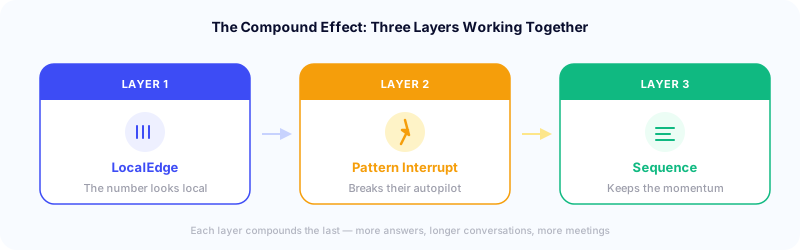
- Pair with local presence — the prospect answers because the number looks local; the pattern interrupt keeps them on the line. CallerGuardian protects your caller ID reputation so those numbers never show “Spam Likely.” These two techniques compound each other. (How local presence dialing works)
Track which openers work by tagging calls with structured call outcomes.
The Bottom Line
Pattern interrupts are not tricks. They’re a response to the reality that prospects are flooded with outreach and have developed automatic defenses against it. A good interrupt simply earns you the chance to have a real conversation — what you do with that chance is what actually matters.
Start with one opener that feels natural to you. Test it on 50 calls. Measure how many conversations you get past the first 30 seconds. Then iterate.
The reps who succeed with pattern interrupts aren’t the ones with the cleverest scripts. They’re the ones who use the interrupt to open a door and then follow through with genuine curiosity about the prospect’s situation.
Symbo’s dialer with local presence gets your foot in the door. Your pattern interrupt keeps it open. Book a demo to see it in action, or check out pricing to get started.