What Is Local Presence Dialing?
Local presence dialing is a calling technology that automatically matches your outbound caller ID to the area code of the prospect you’re calling. Instead of your prospect seeing an unfamiliar toll-free or out-of-state number, they see a local number they’re more likely to pick up.
Here’s the simple version: if you’re based in Chicago but calling a prospect in Dallas, your caller ID displays a 214 or 972 area code instead of your 312 number.
The dialer maintains a pool of real, owned phone numbers across different area codes. When you dial, the system detects the prospect’s area code, selects a matching number from the pool, and displays it as your caller ID. If the prospect calls back, the system routes the callback to you — so the number actually works.
This is different from caller ID spoofing. Spoofing uses fake numbers that can’t be called back and is done with intent to deceive. Local presence uses real, leased numbers with legitimate business intent. That distinction matters legally.

The Answer Rate Problem
Cold calling has an answer rate problem. Most prospects screen calls from unknown numbers, and toll-free or out-of-area numbers are the first to get ignored.
The data backs this up. A Software Advice survey found that prospects are nearly four times more likely to answer calls from local numbers — 27.5% for local area codes versus just 7% for toll-free numbers. That’s a massive gap, and it explains why so many cold calls never get past the first ring.
Separate data from PanTerra Networks shows even wider spreads in some contexts: 25% answer rates with 800 numbers climbing to 40% when using matching local area codes.
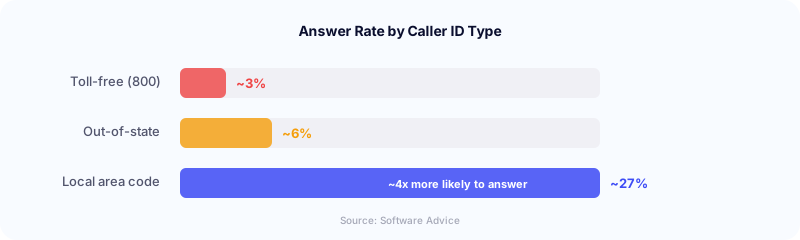
The reason is straightforward — people trust local numbers more. An unknown 800 number feels like a sales call. A local number could be a doctor’s office, a school, a neighbor. It gets the benefit of the doubt.
How Local Presence Dialing Works (Technically)
The process happens in milliseconds, but here’s what’s going on behind the scenes:
1. Number Pool Provisioning
Your dialer provider maintains a pool of DID (Direct Inward Dialing) numbers across hundreds of area codes. These are real phone numbers leased from carriers — not generated or spoofed. A well-provisioned system maintains thousands of numbers across its pool — dozens per area code at minimum — to enable proper rotation and keep numbers fresh.
2. Area Code Matching
When you initiate a call, the system reads the prospect’s phone number, identifies the area code, and selects a matching local number from the pool. This happens automatically — the rep doesn’t do anything different.
3. Outbound Call Routing
The call is placed through the selected local number. The prospect’s caller ID shows the local number, and the call is routed to the rep’s line.
4. Callback Handling
If the prospect misses the call and calls back, the system routes the callback to the original rep (or to a general queue, depending on configuration). This is critical — the number must work for callbacks, otherwise you lose credibility and risk compliance issues.
5. Number Rotation
To protect caller ID reputation, the system rotates through multiple numbers within each area code. Calling too many prospects from a single number (more than roughly 50 calls per day per number) can trigger spam flags from carriers. Rotation spreads the load.
Is Local Presence Dialing Legal?
Yes — when done properly.
The relevant law is the Truth in Caller ID Act (Section 227(e) of the Communications Act), which prohibits transmitting “misleading or inaccurate caller ID information with the intent to defraud, cause harm, or wrongfully obtain anything of value.”
The key word is intent. Local presence dialing uses real, owned numbers that can be called back. The intent is to increase connection rates through familiarity, not to defraud. This distinguishes it from illegal spoofing, where callers display numbers they don’t own with the intent to deceive.
That said, compliance still requires:
- Real numbers you own or lease — the displayed number must be a working number that routes back to your business
- Full TCPA compliance — local presence doesn’t exempt you from Do-Not-Call registry scrubbing, calling hour restrictions (8 AM–9 PM local time), or opt-out requirements
- Accurate business representation — you’re still required to identify yourself and your company on the call
- STIR/SHAKEN attestation — carrier authentication protocols assign trust levels to calls. Numbers hosted by a different carrier than your originating carrier without proper registration can receive a B-level attestation downgrade, which increases the chance of spam flagging
STIR/SHAKEN and Spam Filtering
The FCC mandates STIR/SHAKEN, a caller authentication framework that assigns trust levels (A, B, or C attestation) based on how confident the carrier is that the caller is who they claim to be.
For local presence dialing, this matters because:
- A-level attestation (full trust) requires the originating carrier to verify the caller has the right to use the displayed number
- B-level attestation (partial trust) means the carrier verified the caller but can’t confirm they’re authorized for that specific number
- If your local presence numbers are hosted on a different carrier than your originating trunk, you may get downgraded to B-level, making spam flagging more likely
The fix: work with a provider that maintains proper carrier relationships and registration for their number pools. This ensures your local presence numbers receive full STIR/SHAKEN attestation. (Symbo’s LocalEdge signs every call with Level A attestation by default.)
Caller ID Reputation Management
Local presence dialing only works if your numbers maintain a clean reputation. Here’s what degrades reputation:
- High call volume from a single number — more than ~50 outbound calls per day per DID increases risk
- Low answer rates — carriers track how often calls from a number go unanswered
- Short call durations — many very short calls signal robocalling behavior
- Recipient spam reports — if prospects mark your number as spam, the carrier takes notice
- Rapid sequential dialing — calling numbers in rapid succession from the same DID triggers automated filters
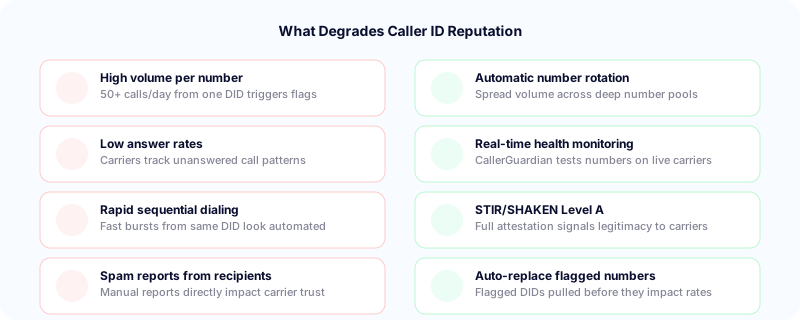
Best practices for maintaining reputation:
- Rotate numbers within each area code pool (at least 10-15 numbers per active area code)
- Cap calls per number at 40-50 per day
- Monitor number health — track answer rates and spam reports per number (tools like Symbo’s CallerGuardian automate this)
- Replace flagged numbers promptly — if a number gets labeled as spam, retire it and provision a new one
- Separate inbound and outbound — don’t use your main business line for outbound campaigns
The Downsides (And How to Manage Them)
Local presence isn’t perfect. Here’s what to watch for:
Perceived deception. Some prospects feel tricked when they discover you’re not actually local. If a Dallas prospect picks up expecting a local business and gets pitched by someone in Chicago, trust can take a hit. The fix: be upfront about who you are and where you’re calling from early in the conversation. Don’t pretend to be local.
Number management overhead. Maintaining pools of numbers across hundreds of area codes, rotating them, monitoring reputation, and replacing flagged numbers is operational work. Most teams rely on their dialer platform to handle this automatically.
Spam flagging still happens. Even with legitimate numbers, high-volume outbound calling can trigger spam filters — especially if your list quality is poor and you’re hitting a lot of disconnected or wrong numbers. Clean data is the foundation that makes local presence effective.
Cost. Provisioning and maintaining large number pools adds cost. Some providers include local presence in their base price; others charge per number or per area code.
Who Should Use Local Presence Dialing?
Strong fit:
- Inside sales teams doing high-volume cold calling (SDRs, BDRs)
- Teams calling prospects across many different regions or states
- Organizations where answer rate is the primary bottleneck in the sales funnel
- Companies in industries where prospects are especially likely to screen calls (insurance, solar, real estate, recruiting)
Less critical:
- Teams calling primarily within a single metro area (you already have a local number)
- Account executives making warm follow-up calls to known contacts (though number rotation and spam monitoring still protect your caller ID reputation even on warm calls)
- Teams with very small call volumes (the operational overhead may not be worth it)
Symbo’s LocalEdge is our local presence dialing feature. It automatically matches your outbound caller ID to the prospect’s area code from a deep pool of thousands of numbers across the US, Canada, UK, and Australia — with 100+ additional countries available on request.
What makes it different from other local presence dialers:
- Carrier-intelligent matching — LocalEdge doesn’t just match the area code. On every US call, it looks up the prospect’s carrier (AT&T, Verizon, T-Mobile) and selects a number that’s verified clean on that specific network. A number flagged on Verizon won’t be served to Verizon subscribers.
- Deep number pools with automatic rotation — not one number per region, but dozens. Numbers are rotated intelligently to distribute call volume and prevent overuse. When a number gets flagged, it’s swapped out automatically.
- Integrated with CallerGuardian — Symbo’s real-time spam monitoring tool continuously monitors your LocalEdge numbers by placing real test calls on major carriers. Flagged numbers are pulled from rotation and replaced before they impact your answer rates.
- Full STIR/SHAKEN Level A attestation — every call is properly signed, telling carriers your calls are legitimate and reducing the chance of spam flagging.
- Callback routing — missed calls route back to the original rep, so prospects always reach the right person.
- CRM sync — every call, callback, and number used is logged automatically in HubSpot, Salesforce, Bullhorn, and more.
Local Presence + the Right Dialer Mode
Local presence dialing gives you the right number on caller ID. But the dialer mode you pair it with determines how many conversations your team actually has.
Symbo’s sales dialer offers three modes, all with LocalEdge built in:
- Parallel dialer — dial up to 4 lines simultaneously and connect to the first live answer. Maximum speed for high-volume prospecting.
- Power dialer — automatically dials the next number when you finish a call. Steady, focused pace through your list.
- Click-to-dial — review the prospect’s CRM record first, then click to dial with full context. Best for warm outreach and follow-ups.
Combine any mode with multi-channel sequences — calls, emails, and texts on a schedule with outcome-based automation — and you have a complete outbound system where local presence is just one piece of the puzzle.
Getting Started
If you’re making outbound calls and your answer rates are below 15-20%, local presence dialing is one of the highest-leverage changes you can make. It doesn’t require changing your script, your list, or your team — just the number that shows up on the prospect’s phone.
Start by measuring your current answer rate (Symbo’s coaching and analytics dashboard tracks this automatically across your team). Then run a test: split your list and call half with your standard number and half with local presence enabled. Compare the connection rates. Most teams see the difference within a single day of calling.
Ready to see local presence dialing in action? Book a demo and we’ll show you how LocalEdge works with your team’s workflow. Or check out our pricing to see what’s included in each plan.